
COCO does the Mediterranean: Part Two
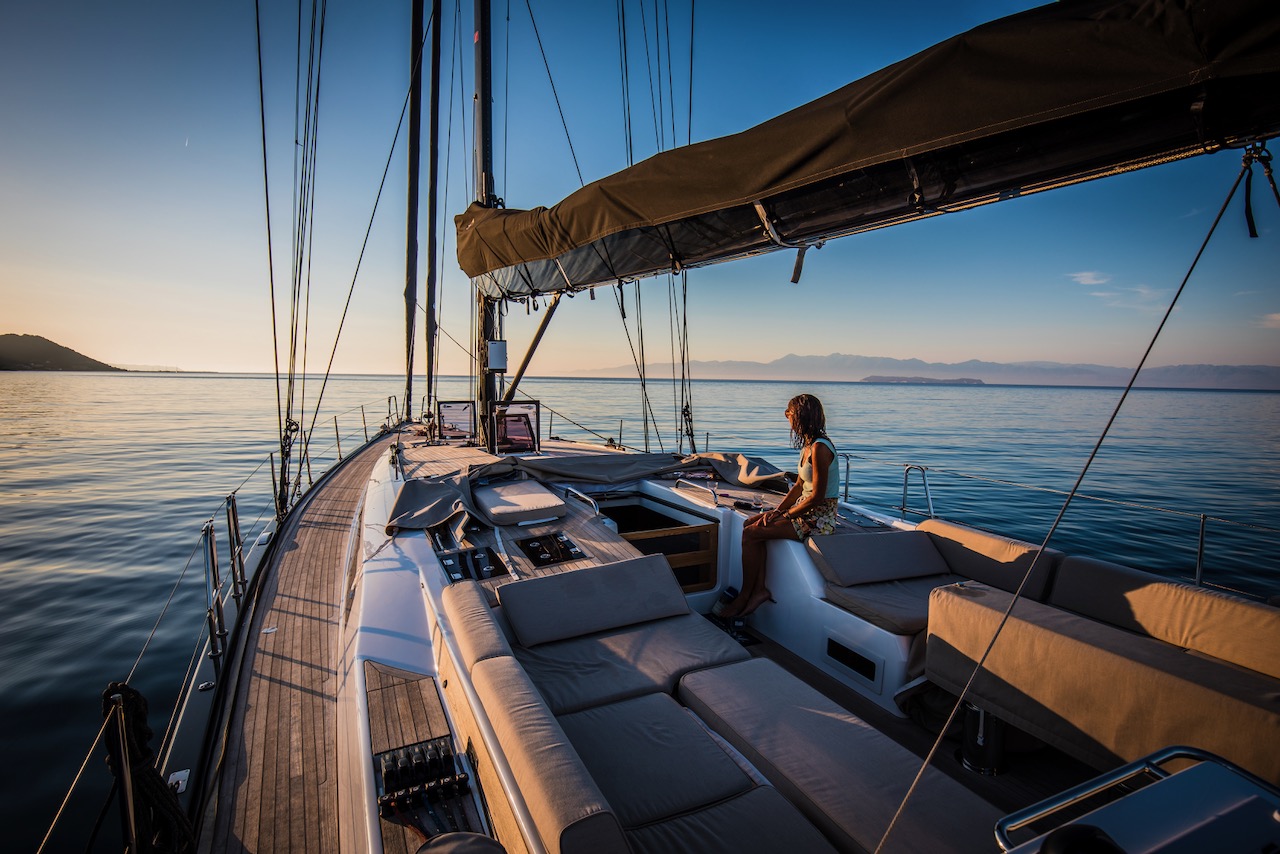
The Greek Ionian to Athens.
With the first leg of our trip out of the way, Barcelona via Italy, we finally arrive at our intended destination, the Ionian Islands; a month late, given our lingering in Sicily and the Aeolian Islands. COCO, our lovely Swan 58, is still sailing like a dream. Absolute clockwork.
With that, let’s get onto the Greek Sector that was garnished liberally with mostly good weather, some great hiking and many delicious family run Tavernas in secluded little port towns. We are now in early June, and we all know what that means; the charter yachts and flotillas emerge out of their winter hibernation like hungry bears to assault our sense of harmony…
As a reminder of our 2025 sailing route so you can see where this sector fits into the season:
- Leg One → Barcelona, Menorca, Sardinia, Sicily, Aeolian Islands, Strait of Messina, to the “Boot” of Italy.
- Leg Two (this sector) → the Ionian; Corfu, Paxos,Antipaxos, Kefalonia, Ithaca, Kalamos, Kastos, south around the Peloponnese Peninsula, back north to the Saronic Islands, then east to Attica (Athens peninsula).
- Leg Three (later in the season) → the Cyclades, then further east and before sailing north through the Dodecanese Islands (in the eastern Aegean right across on the Turkish Coast), before heading to Lavrio, just south of Athens where COCO sleep for the winter. More on that in Part Three of COCO does the Mediterranean (when I actually get around to writing it).
Kaliméra Corfu → Where the Journey Begins
Ah the Ionian – it’s always been on my bucket list. Gentle winds, calm unoccupied anchorages (a little deluded I know…), classic Greek landscapes and damn fine food. Our first stop was the small island of Erikousa just north of Corfu. We were heading to the D-Marin Gouvia Marina just north of Corfu town to do the obligatory Greek check-in and customs procedures, but the anchorage on the south end of Erikousa with its white sand beach and small taverna on the water was just too tantalising for us. So, formalities be damned, we dropped the anchor and went ashore for cold beer and fried fresh anchovies. Welcome to Greece!
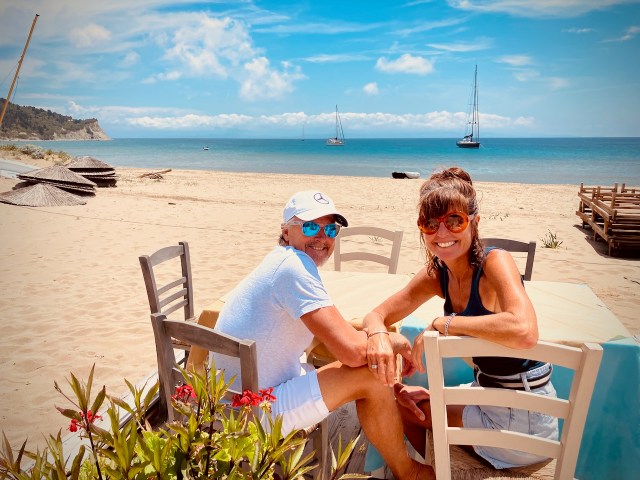
The next morning, we headed to the Marina in Corfu and hit the paperwork and a look around the Corfu Old Town.
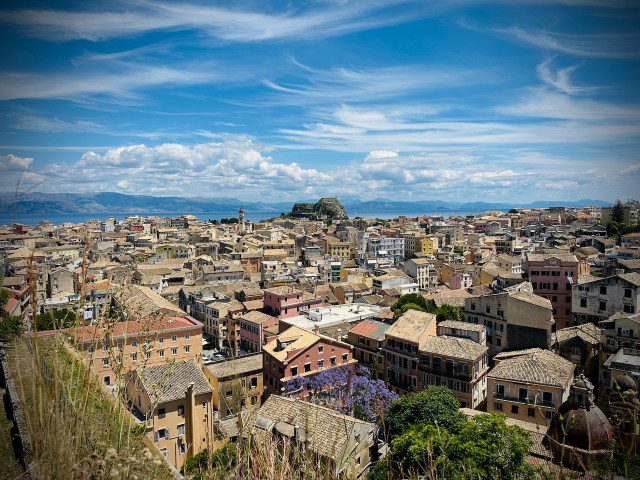
The first thing you notice about Corfu is that it smells like jasmine and old stone and a little bit of adventure that’s been marinating in sunshine for about three thousand years.
Our boat was tied up in the marina in the early afternoon, rocking gently like it was stretching its back after a long sail. I stood on the dock with cold beer in one hand and a chart of the Ionian Islands in the other, trying to look like a man who knew what he was doing.
Now the truth is, sailing the Ionian Sea has a way of making everybody feel like a philosopher. The water’s calm, the wind’s polite, and the islands are scattered around like somebody spilled emeralds across a blue velvet tablecloth.
We also discovered that Albania was a short ferry ride away from Corfu Town, and having never been to Albania, we went for lunch! After a couple of days in the Marina (long enough for us not to be swinging on the anchor), we headed back around the north coast of Corfu to the western side of the island and found a lovely anchorage at Agios Georgios. A nice big wide bay, plenty of sand, good holding and a great base to explore this part of the coast.
Leaving Corfu feels a little like sneaking out of a party that’s still going strong.
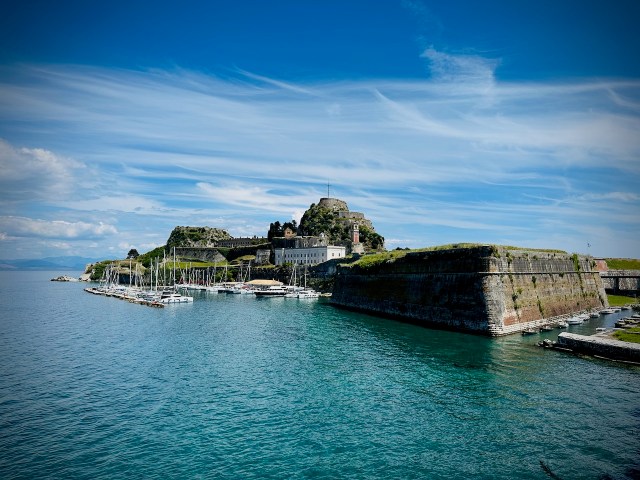
The old Venetian town glows behind you, terracotta roofs stacked like dominoes, church bells ringing somewhere deep in those skinny alleyways where scooters and grandmothers both travel at mysterious speeds.
As the sails go up, the island slowly slides away behind the stern.
Now we get into the bits I really wanted to see; Kefalonia, Ithaca, Kalamos and Kastos. These islands are probably my favourite in the Ionian, but we were heading into mid June, and we all know what that means – charter yachts and flotillas… The plague of the ocean. Fuck they are annoying, and dangerous. I apologise to those who rent charter boats, and you actually know what you’re doing. But quite frankly, as far as I can tell, you’re in a minority group. As for the rest of you, either hire a bloody skipper, or learn some seamanship, and maybe actually read the sailors bible of give way rules We had many occasions where we had to take evasive action to avoid a yacht when we were clearly the stand on vessel. One of them, a catamaran, I resorted to sitting on the fog horn to wake the crew up dozing in the cockpit while they were underway with the autopilot on! Fuck me.
Our favourite time of the day we call “witching hour”. Usually between 4 and 5pm when everyone is coming onto the anchorage for the night. It’s comedy on the water. The number of times we watched 4 or 5 people up the front of the boat after dropping the anchor, knowing they are too close, hoping that they will magically swing away from us. It’s usually a 15 to 20 minute discussion, much discussion, much pointing, more discussion; no change in the situation. It’s at this point in the performance that I put my gin and tonic down, go up the front, and politely suggest that if they think they are too close; they probably are. If the subtle approach doesn’t work, I then calmly explain to them that my angle grinder is very effective in cutting anchor chain and that I hope their insurance covers them for such an event.
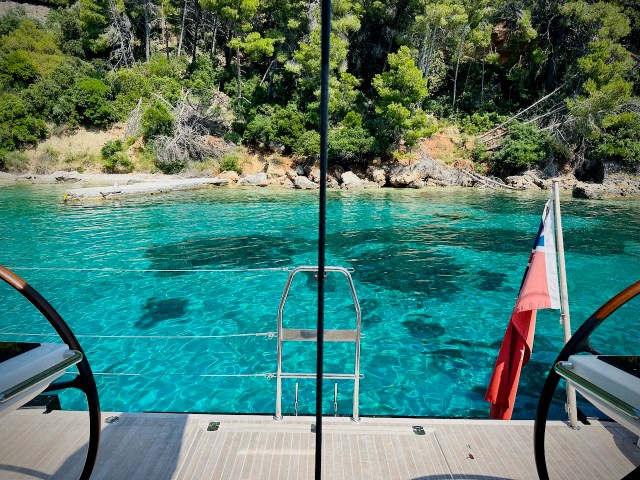
Regardless of the rude awakening that there were actually other people on boats arriving in the Greek Islands for the season, this group of islands is quite lovely. Not my absolute favourite of all the Greek Islands, but nonetheless, worth a visit. When it’s not crowded, there are lovely little bays, great port towns with very good restaurants and some pretty good hiking. However, we did need to learn that Greek Island trick of stern to anchoring and tying up to the rocks. It defies logic. And a little tricky on a 60 foot, 25 tonne yacht with two people onboard. It involves dropping the anchor about 80 metres from shore, backing towards the rocks until your rudders are almost on the bottom, holding the boat there while someone (me) swims a couple of long lines back to the rocks, tying them on to hold the boat in place. Once back on the boat, everything is tightened up and there you are. Close enough to the shore so you can count the crabs on the rocks with about a metre of water under the rudders. Why? Because many of these anchorages are so deep, putting the anchor down close to the shore is the only viable option. It’s not my favourite, but generally effective.
So, let me tell you about my favourite of the Ionian islands:
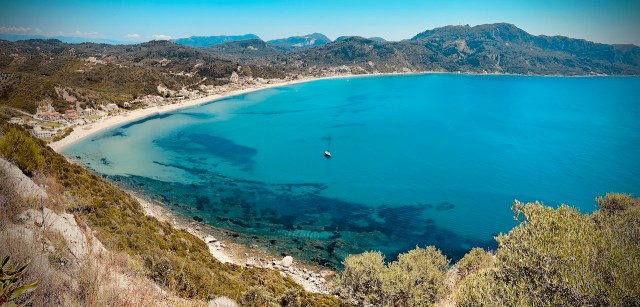
Paxos → The Secret Garden
The island of Paxos rises out of the sea like a secret somebody forgot to tell the rest of the world. Tiny harbour. Bright houses. Boats bobbing around like rubber ducks with expensive hobbies.
We anchor near the village of Loggos where the water is so clear you can see your anchor sitting on the sand looking proud of itself.
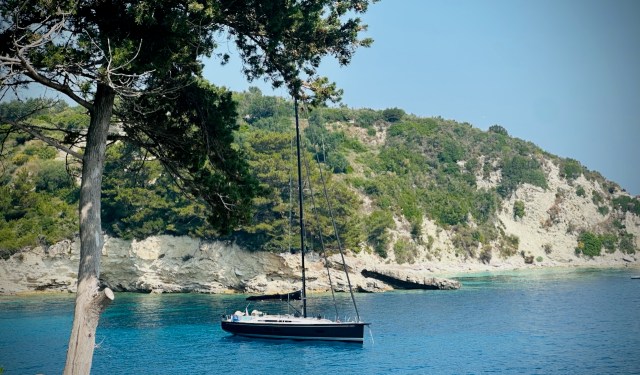
Now Paxos has olive trees. A lot of them. Something like half a million. Which means the whole island smells like olive oil, warm earth, and lunch waiting to happen.
We walk up to a taverna. The owner brings bread, olives, tomatoes, and grilled fish without anyone ordering a thing. That’s Ionian hospitality right there – less menu, more destiny.
Kefalonia → Big, Wild, and Beautiful
Next comes Kefalonia—the big one. Mountains rising straight out of the sea. Forests rolling down to hidden coves. We pull into the harbor at Fiskardo, which somehow looks like every postcard Greece has ever printed.
Sailboats line the quay. Restaurants set tables right next to the water. An old fisherman cleaning nets looks at our boat and nods like he approves of our life decisions.
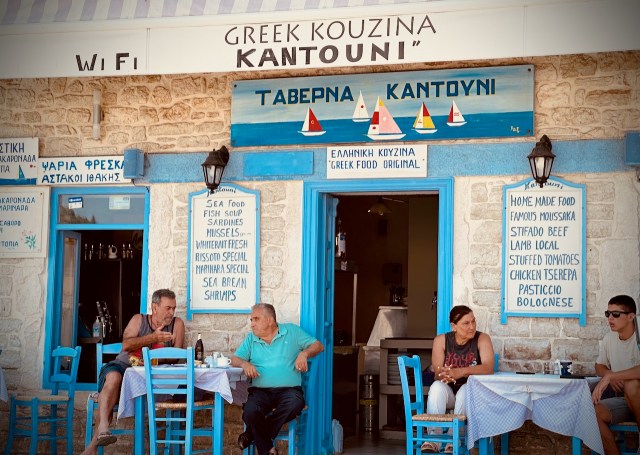
Dinner appears slowly. Grilled octopus. Lemon potatoes. A bottle of white wine that tastes like sunshine and questionable judgment. Somewhere around glass number two I start explaining wind patterns to a cat that definitely did not ask.
Let’s keep this Ionian adventure rolling a little further down the chart… because three little islands slipped quietly into the story while nobody was looking. The kind of places sailors whisper about like secret fishing spots.
Kalamos → The Quiet Giant
Just east of Kefalonia sits the tall, green island of Kalamos. Now Kalamos looks like somebody took a mountain, planted about a billion pine trees on it, and dropped it straight into the Ionian Sea. We sailed into the harbour late in the afternoon with the wind easing down to a gentle whisper. The village was quiet – just a few fishing boats, a sleepy waterfront café, and a couple of old men watching the world the way only old sailors can.
The mountains climb straight up behind the harbour, covered in deep green forest. No big resorts. No crowds. Just cicadas buzzing in the warm air and the smell of pine drifting down from the hills.
The taverna owner walks out, looks at our boat, nods once, and says: “Hungry?”
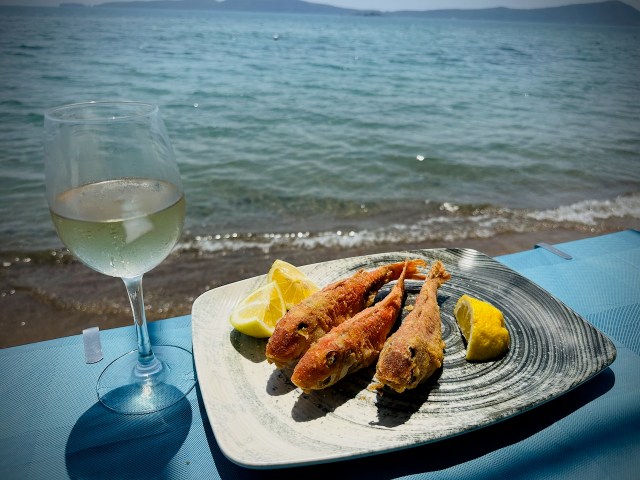
Now that’s my kind of menu. Grilled fish appears. A carafe of local wine follows. Somebody puts fresh bread on the table that disappears faster than you’d expect from a group of supposedly sophisticated sailors. And the whole harbour slowly turns gold as the sun slides behind the hills. Kalamos doesn’t try to impress you. It just sits there quietly… Like a wise old man who already knows the punchline.
Kastos → The Tiny One with the Big Soul
Just a short sail away is Kastos. Now Kastos is small. Real small. You can practically walk around the entire island before your coffee gets cold. The harbour curves into a perfect little horseshoe filled with fishing boats and sailboats that look like they’ve come here specifically to relax.
Anchor down – and suddenly we’re sitting at a waterfront table five minutes later. Cats are strolling around like they own the island. Which, judging by their attitude, they probably do. The taverna owner sets down a plate of grilled squid, a bowl of olives, and a bottle of wine that was definitely not measured by the glass.
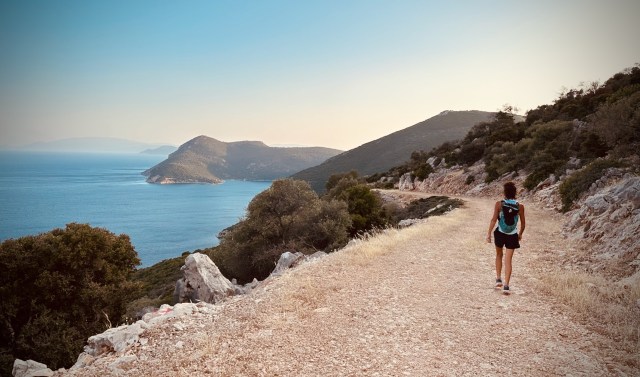
The sea is flat. The air smells like oregano and salt. And the whole harbour is glowing under a soft orange sunset. I lean back in the chair, look out across the quiet water toward the rest of the Ionian Islands, and realize something important. These islands… big ones like Corfu and wild ones like Kefalonia… they’re spectacular. But the tiny ones; Kalamos? Kastos? Ithaca? Those are the places where sailing slows all the way down. Where the harbour goes quiet after dinner. Where the only sound is the gentle clink of halyards on masts and the soft lap of water against the hull.
And sitting there in that little harbour, with the stars beginning to show up one by one above the masthead…. I raise my glass, look out at the calm Ionian night, and say the only thing a man can say at a moment like that. Heaven.
Ithaca – The Mystical One
Ithica was probably my favourite. Maybe it’s because Odysseus spent quite a bit of time here.
So let me tell you about Odysseus and his time on Ithica…. Imagine this. It’s the early 1820s. The sun’s shining over Greece, the sea’s doing that sparkling thing it does, and wandering through the ancient world like a rockstar with a notebook is Lord Byron.
Now Byron wasn’t exactly the quiet tourist type. This guy travelled like every hilltop ruin might inspire the next great poem – and maybe a little scandal along the way. One day he lands on the island of Ithaca. Now if that name sounds familiar, it should. Ithaca is the legendary home of Odysseus – the crafty king from The Odyssey who spent ten years sailing around the Mediterranean trying to get home… running into monsters, witches, storms, and the occasional bad decision.
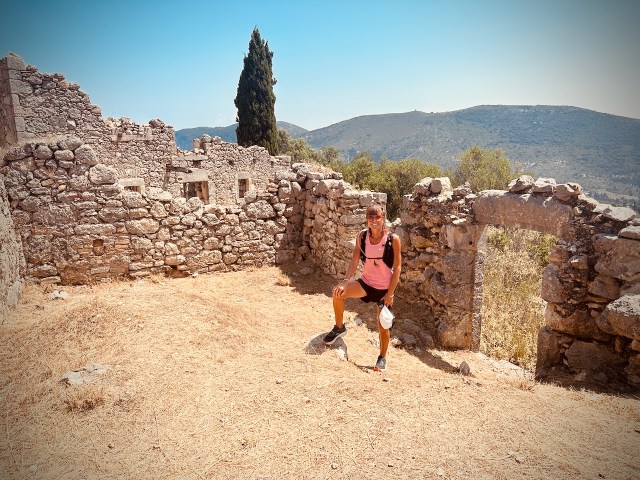
The locals take Byron up a rocky hillside and point to a strange ruin carved right out of the mountain. They say, “Right here… this is the School of Homer.” Now if you’re a poet standing in Greece and someone tells you you’re at the “School of Homer,” your heartbeat probably does a little drum solo. According to local legend, the place used to be a shrine to Odysseus himself. And legends like that? Well, they tend to attract archaeologists.
Soon enough, folks start digging. One of the earliest was Heinrich Schliemann – the same guy famous for finding Troy… though he also accidentally bulldozed a chunk of it in the process. Enthusiasm sometimes outruns precision. For more than a century, archaeologists kept searching that hillside – sifting dirt, cataloguing pottery, arguing about dates. And finally, after nearly twenty years of excavation, researchers from the University of Ioannina came back with something special.
Proof.
They uncovered a small bronze bust of Odysseus from Roman times. Nice start.
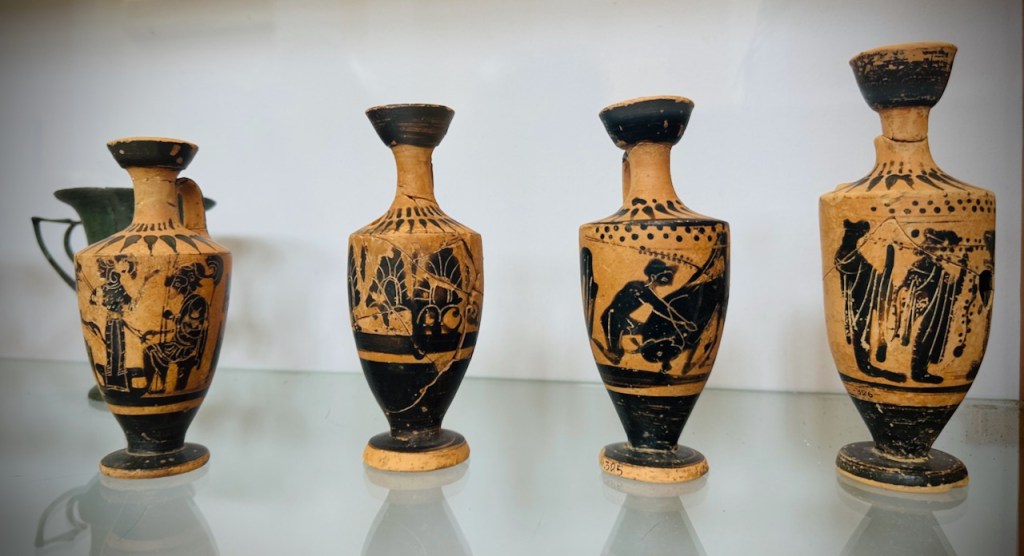
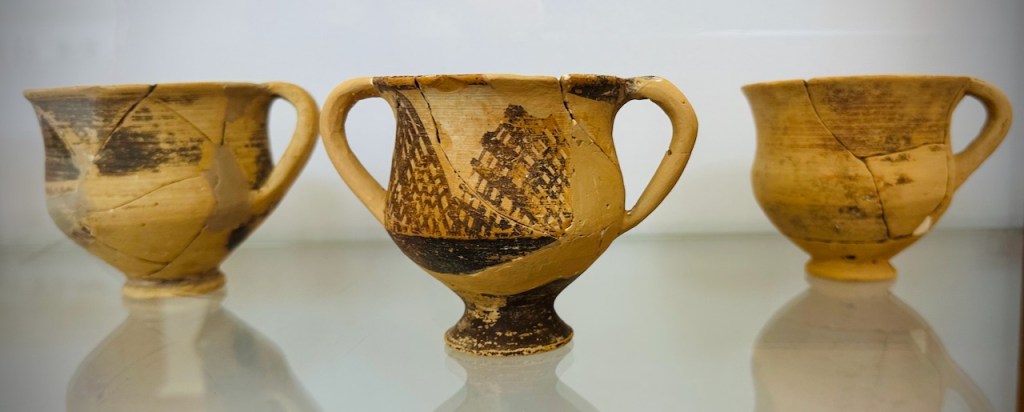
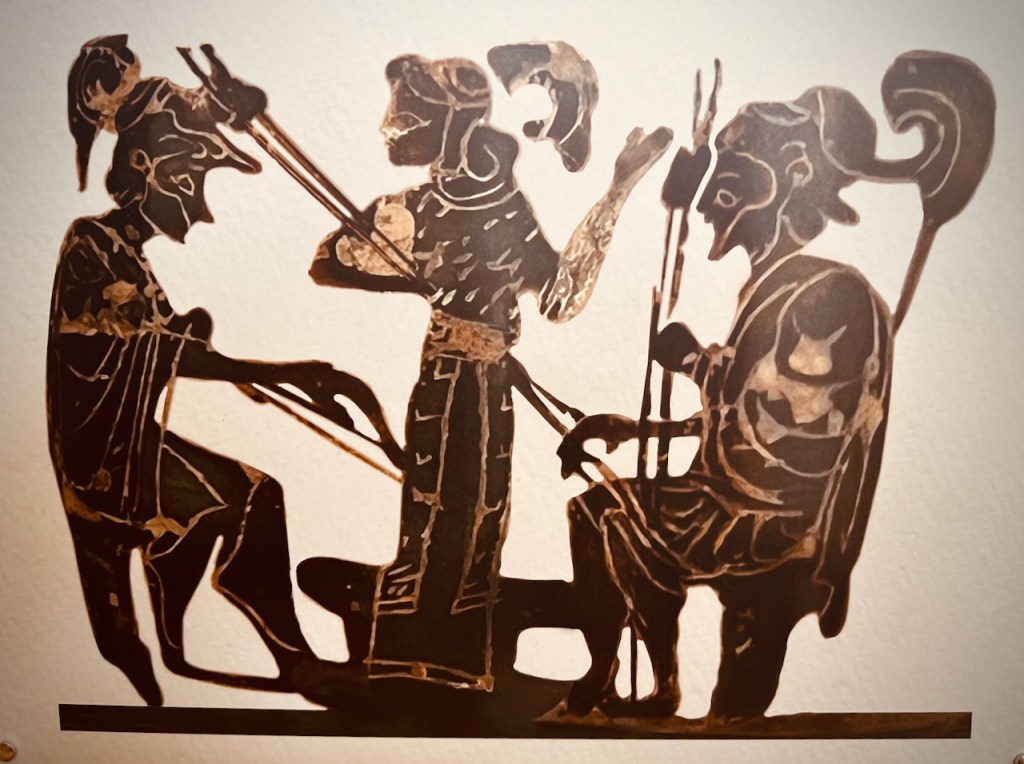
Then they found a roof tile carved with a dedication: “To Odysseus.” Pretty clear message. But the real jackpot was another roof tile stamped with his name in the possessive – basically saying this place belonged to him.
Turns out people began worshipping Odysseus there around the 4th century B.C.E., centuries after The Odyssey was written and about a thousand years after the legendary king supposedly made his long trip home.
The shrine itself sits inside a huge natural rock formation with towers, terraces, and buildings carved into the stone – part sanctuary, part lookout over the nearby harbours.
In other words… a pretty good place to honour a guy known for watching the horizon.
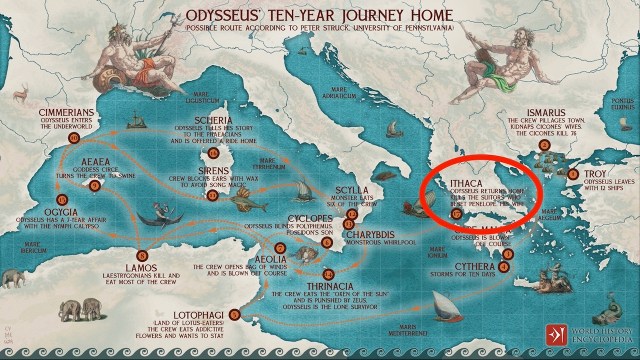
Now people always believed Odysseus had fans on Ithaca. His face showed up on coins, and offerings in nearby caves matched the gifts described in The Odyssey. But now archaeologists have found the epicentre – the spot where ancient travellers climbed the hill, brought offerings, and paid their respects to the Mediterranean’s most famous wanderer.
And if you think about it… that’s kinda fitting. Because Odysseus spent a lifetime trying to get back home. And thousands of years later, people are still finding their way back to him.
My last mention of Ithica is a piece of food deliciousness I need to share with you; a dish we found in a wee taverna in one of the port towns called Savoro. It’s a really weird combination but bear with me. This is so good it’ll make your eyes water. It’s fundamentally small fried fish with a sweet and sour dressing – I know you’re thinking Chinese Sweet and Sour Pork; stop it. This is classy, flavoursome and just downright delicious…
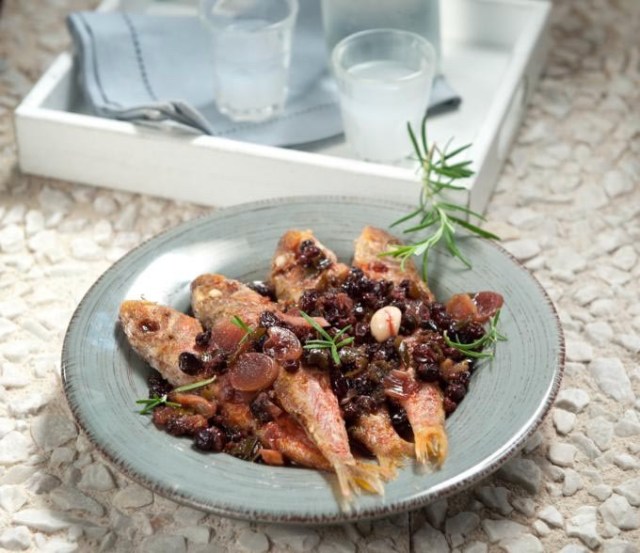
Ithacan Savoro – Greek Silver Whiting with Currants, Rosemary & Vinegar
Ingredients:
You will need… For the fish
- 1 kg silver whiting with heads intact, gutted and scaled (or those lovely wee Red Mullets)
- 1 cup plain flour
- 2 teaspoons salt
- Extra virgin olive oil
For the sauce
- 4 cloves garlic thinly sliced
- 6 sprigs rosemary leaves removed from stalks
- 2 cups dried blackcurrants (or I guess you could use raisins)
- 350 ml good vinegar
How to… Cook the fish
- Combine the flour and salt in a broad flat bowl. Set aside (don’t flour the fish until immediately before cooking – it’ll turn into glue)
- Whack enough olive oil in to pan to a depth of 3-4 mm and heat.
- Fry said fish until golden brown and crispy both sides. Set aside.
How to…. Make the sauce
- Once all the fish have been fried, remove all but a few tablespoons of oil from the pan and reduce the heat.
- Add the slices of garlic and the rosemary leaves to the pan. Fry these a little.
- Add the blackcurrants to the pan.
- Slowly add the vinegar. Stir and reduce the sauce until the blackcurrants have absorbed most of the vinegar and the liquid has thickened.
How to… Eat the damn thing
- Throw the fish back in the pan
- Spoon the sauce on top of the fish
- Eat with abandon
A brief summary of our time in the Ionians:
We drop anchor. Swim. Float. Stare at the cliffs.
And somewhere in the middle of that perfect Ionian afternoon, with the boat rocking gently and the sun warming your face, you realize something. Sailing these islands isn’t really about the sailing. It’s about the rhythm.
Wake up. Raise sails. Chase the afternoon wind. Swim somewhere ridiculous. Eat something grilled. Drink something cold. Watch the sun melt into the sea.
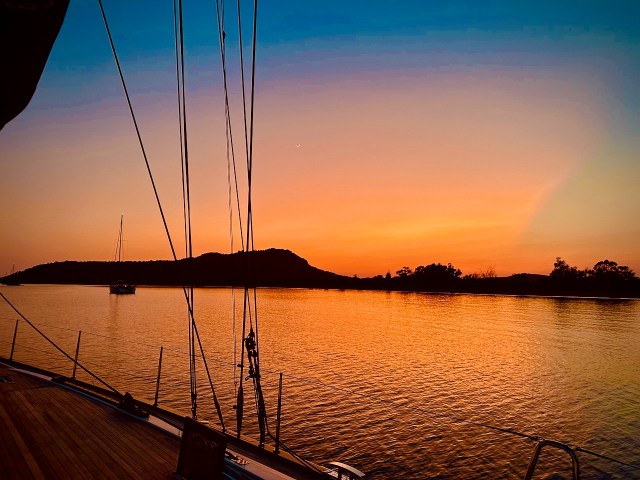
And lean back in the cockpit as the sky turns pink and the anchor chain hums softly under the boat. Then you look around at the islands, the sea, the crew, and the whole ridiculous miracle of it all and realise that life ain’t so bad…
Ionian to Athens → In Search of Poseidon
First, a decision point. Most yachties sailing from the Ionian to Athens use the Corinth Canal; completed in 1893, it’s a 6.3 km long, 25-meter-wide waterway that connects the Gulf of Corinth with the Saronic Gulf, cutting through the Isthmus of Corinth to separate the Peloponnese from the mainland. Originally conceived in the 7th century BC, the project saw failed attempts by Roman Emperor Nero before a 19th-century French company, and later a Greek company, finally completed it after 11 years of digging. I mean it’s still not perfect; every few years it seems to close for extended periods when the walls collapse into the canal.
But us? No. After a bit of reading, it sounded like taking the long way, all the way around the Peloponnese Peninsular, was supposed to be quite pleasant. And for the most part, it was! Less populated by fellow yachties, in some ways, it was a bit of a relief after the busy Ionian. Our first stop in Katakolo was lovely, and the next one further down the coast in Navarino Bay, was just magical.
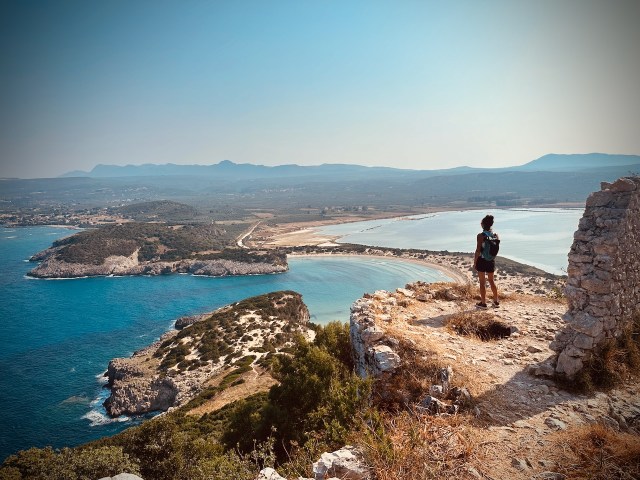
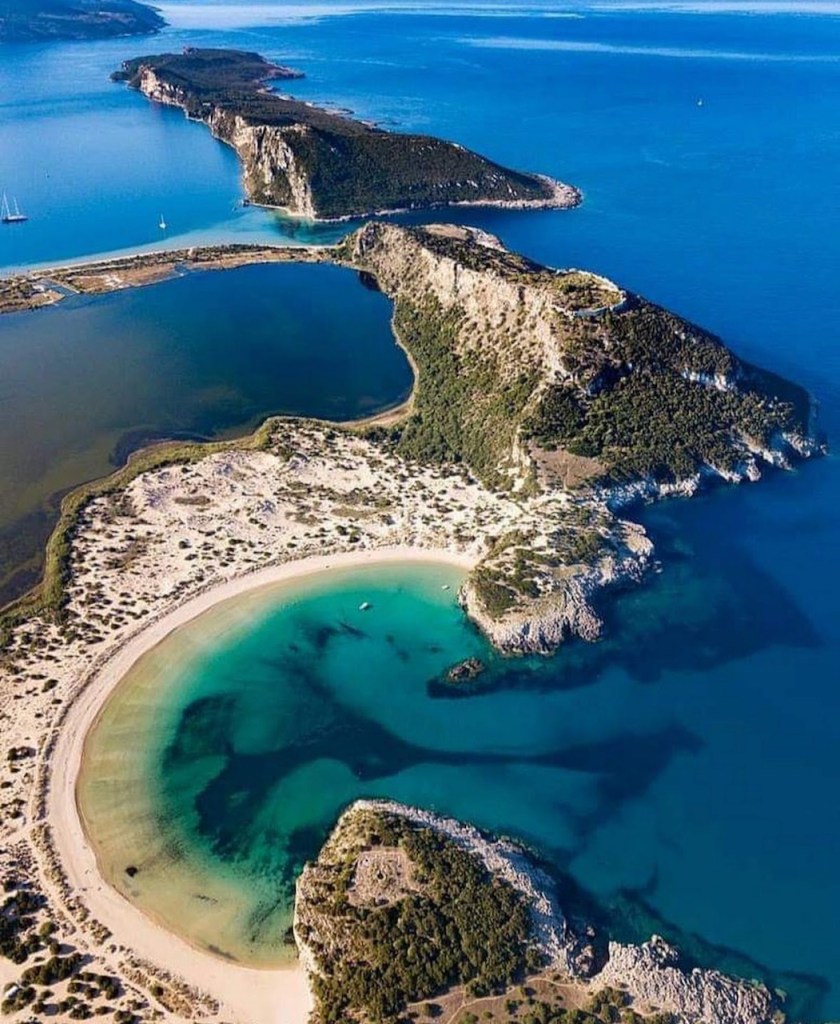
Nestor hung out here in 1300 BC (he built a lovely palace and had a man cave that he liked to hide in), Homer chatted about this place in his Odyssey, and in 1827 Great Britain, France, and Russia had a massive scrap with the Turks and Egyptians in one of the last great sailing ship battles in history. These days it’s one of the biggest and safest harbours in the Mediterranean. We like! It’s a really great anchorage, some good hiking and as you can see from my notes above, plenty of history for the wannabe archaeologists. Well worth a stop.
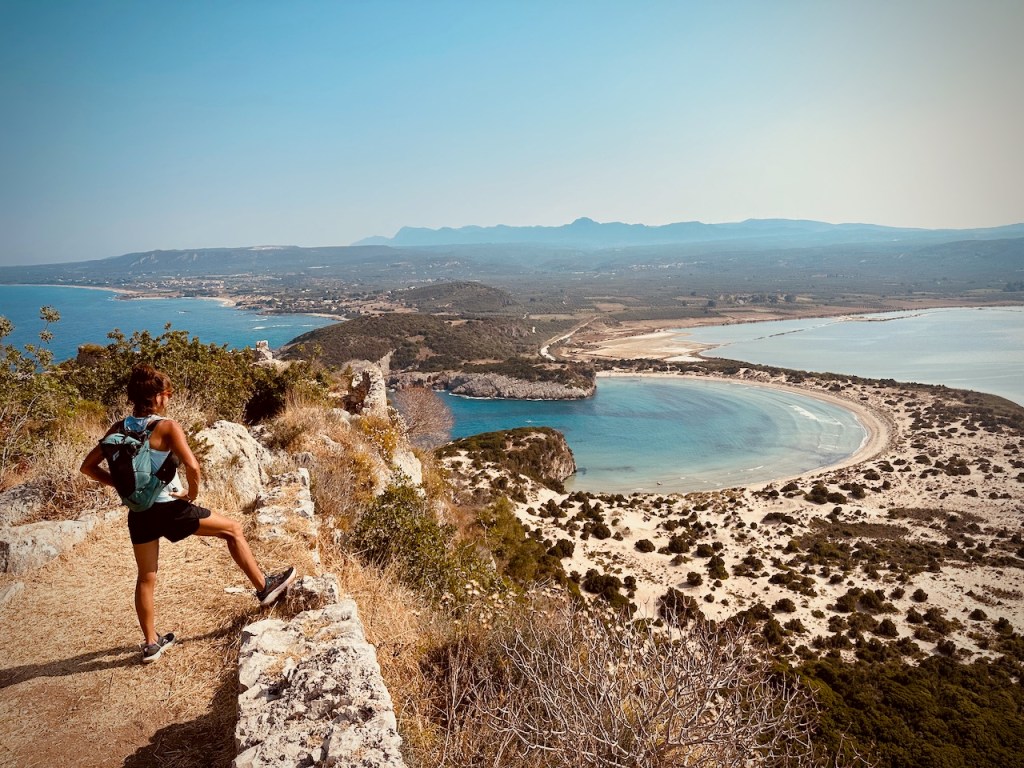
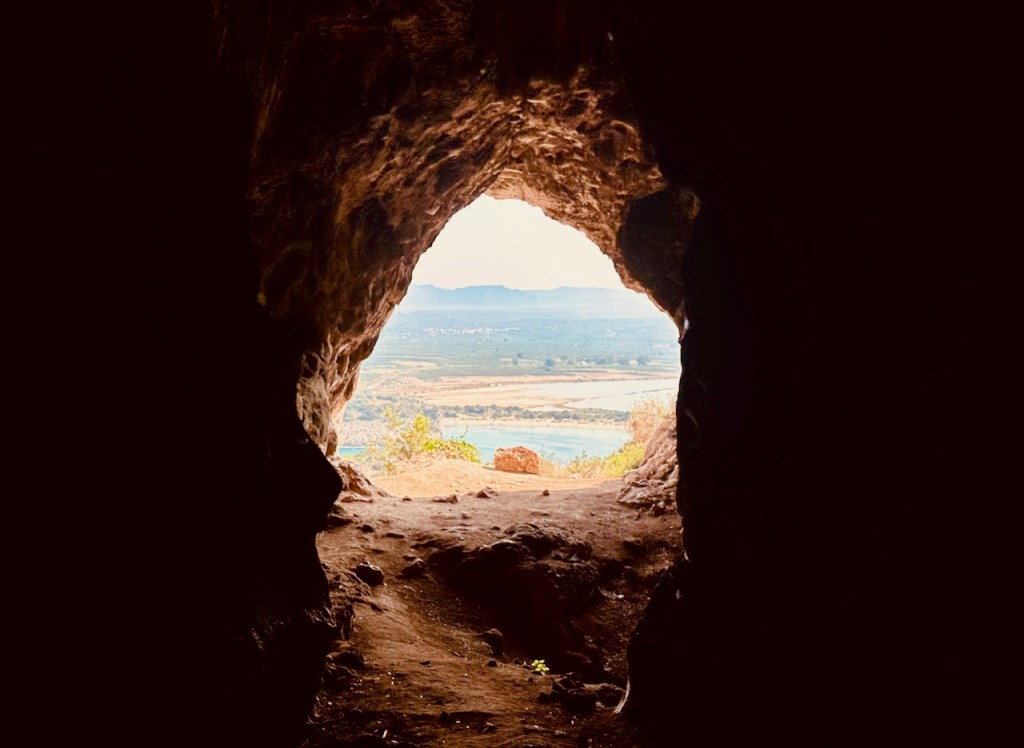
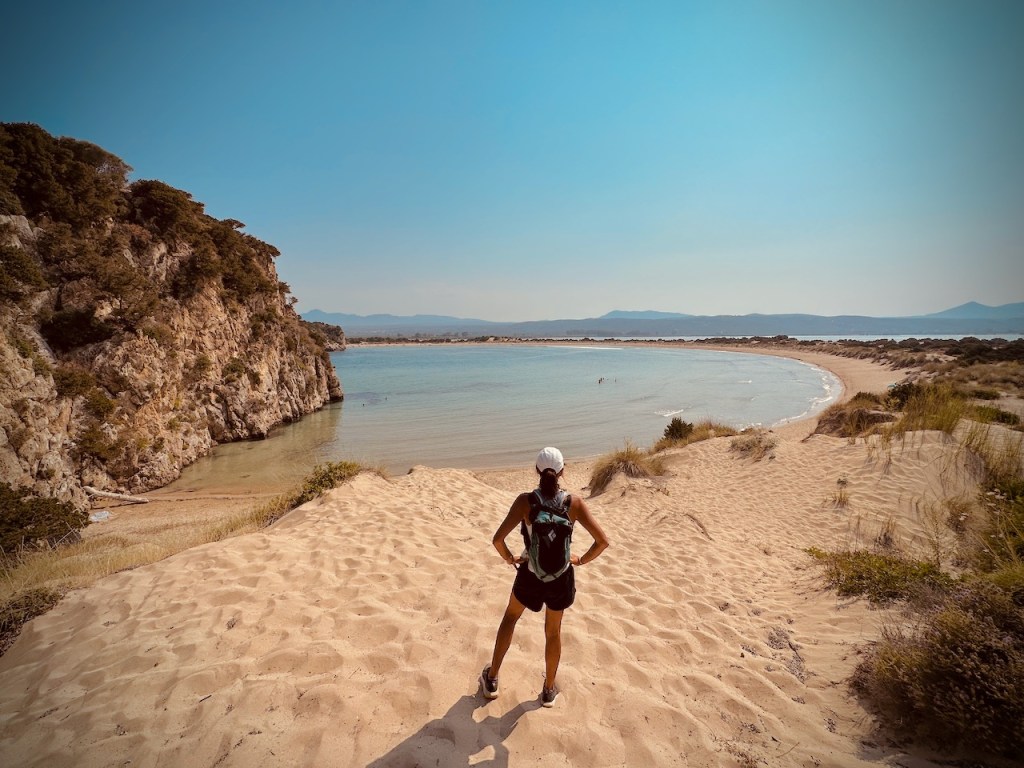
After a few more stops down the coast, just when everything was going so well, we cross the Gulf of Laconia heading to Simos Beach, Elafonisos in the southern Peloponnese. We knew it was going to be a bit windy, but the forecast was wrong. 35 knots on the nose.
We finally get the anchor down in Simos Beach after beating into the wind for hours, it’s beautiful, with a good hold; finally starting to relax after taking a bit of a walloping on our crossing. We watch a yacht full of crazy Italian’s nearby, start to drag. We do the right thing, and yell across the water to alert them to their complete lack of situational awareness, and of their impending doom. Instead of elegantly picking up their anchor and resetting, the skipper puts the hammer down and drives straight across our anchor and snags it.
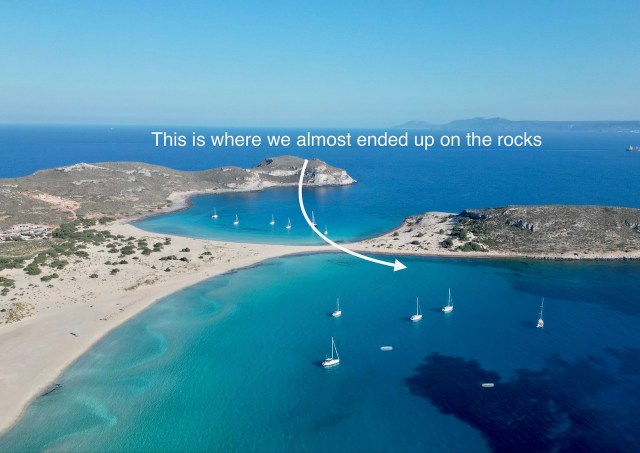
Shit. We are helpless, as they start dragging us towards the rocks in 30 knots of wind, yelling and screaming. I manage to get them to pull our chain up and try to remove it from their anchor. The rocks are getting closer and all the other boats in our path are trying desperately to get out of the way. There are 6 other yachties standing and watching our desperate attempt to stay off the rocks and not one of them gets off their boat to come and help us, which we badly needed. The Italians clearly have no idea what they are doing. More yelling and screaming.
I’m desperately trying to hold the boat; Jacqui is trying to manage the anchor. There’s nothing else we can do. In a last act of desperation, I get on the radio and call the super yacht parked in the bay and ask for help. They immediately put 3 crew into their tender and come racing across. They get on the Italian yacht, manage to unhook our anchor and set us free. By this stage we are getting so close to the rocks I think we are done for. Another 5 minutes and COCO would be no more.
I now have a new respect for the professionalism of super yacht crew and to the guys on Valla II, we thank you from the bottom of our hearts. To all the other yachties in the bay who did nothing to help, you are unbelievable. Watching us through your binoculars and filming the disaster unfolding is unacceptable. As for the Italians who nearly sunk our boat, then proceeded to drag again before leaving the bay, you fucking idiots. You shouldn’t be allowed on the ocean (back to my previous comments about charter boats).
As for us, we re-anchored as far away from everyone else as possible, opened a bottle of wine and looked at each other in disbelief trying to unravel what just happened. It was traumatising and 45 minutes of hell, feeling completely helpless as some idiot tries to put your boat on the rocks. And if you wonder why COCO is now supporting Alinghi Red Bull Racing in the next Americas Cup, look up the owner of the super yacht, Valla II, that saved our arses. After watching the crazy Italians across the bay, drag yet again, they departed the bay. We decided to sit it out for a couple of days waiting for the wind to abate.
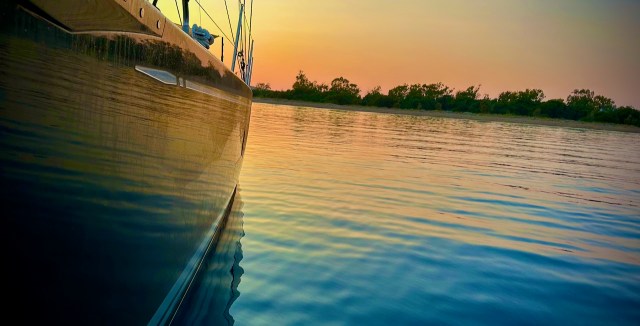
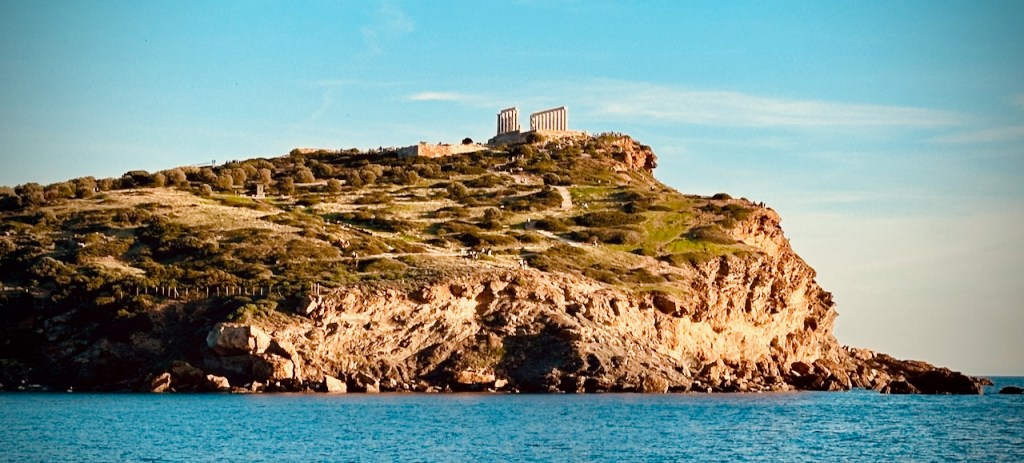
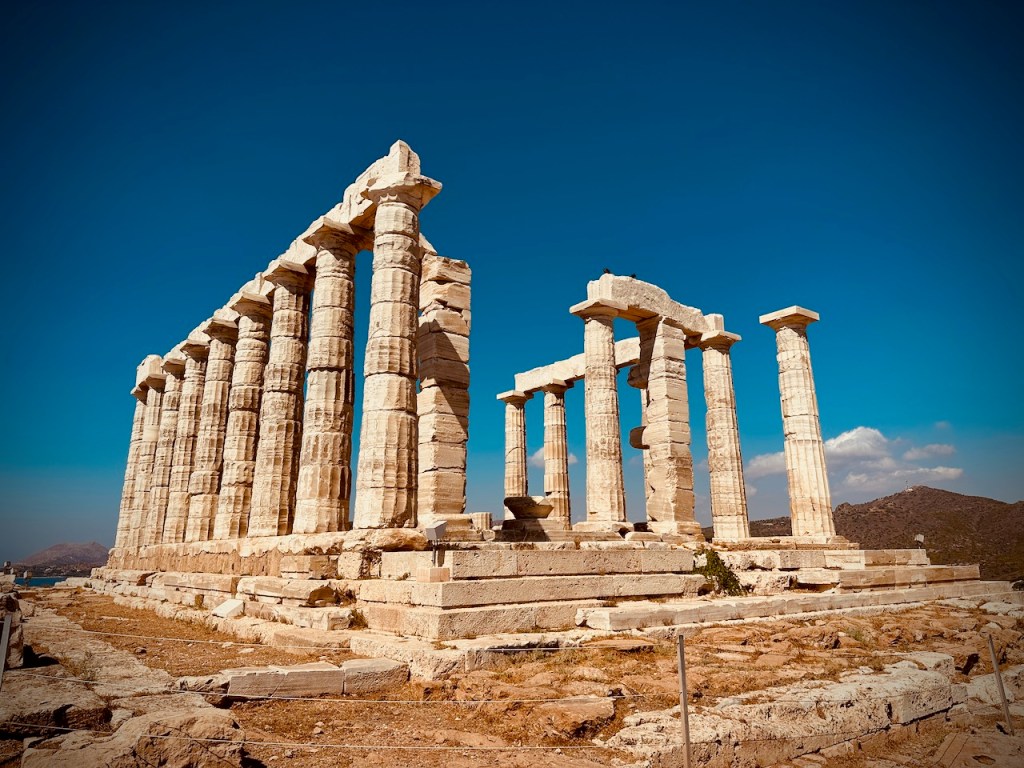
Now we are starting to run out of time; it’s the end of June and it’s getting hotter than Haides. No wind, the thermometer is nudging 40 degrees, too many charter boats; time to get out of the Med for a couple of months. So we head north to the Sardonic Islands, a quick look at Hydra, a few days in Poros (by this time my wife is starting to melt by 10am), A quick tribute to Poseidon sitting in his temple on the end of the Attica Peninsular (and for his protection over us in the aforementioned “Italian Incident”), before heading around the corner to Olympic Marina in Lavrio where COCO is coming out of the water for a couple of months to keep her safe from the marauding charter boats while we bail back to New Zealand to hide from the heat and the chaos of sailing July and August in the Med.
The other two parts of our Mediterranean Odyssey:
Leg One is here (Barcelona to Italy)
Leg Three is here (The Cyclades and Dodecanese)
 Sailing Yacht Coco
An awesome read thanks. I truly felt I was there in each of the ports. Looking forward to the next instalment. Thanks so much, Tina 🙂
LikeLike
Hi Tina – thanks for the read. I’m glad you enjoyed! Alex.
LikeLike
Yep, regardless of where one is in the world the Witching Hour is the best entertainment around while idiots have zero clue on dropping the hook and up there with boat ramp drama.
So along with your entertainingly good travel guide writing perhaps a You Tube Channel featuring the Anchor Muppets.
Honestly struggling to cope with too many good things you are doing. 😓 but keep doing it!
LikeLike
Haha. It’s hard enough for me to make my fingers focus on writing stuff. I don’t think my attention span has the capability to film and edit video! Thanks for the read. Much appreciated.
LikeLike
Pingback: COCO does the Mediterranean: Part Three | Sailing Yacht Coco